
UAA Environmental Message - January 2026
IVM Supports Watershed Health Under a Warming Climate
Climate change and extreme weather events stress U.S. waterways by altering rainfall patterns, intensifying storms, and raising stream temperatures. This results in increased surface runoff, more sediment and nutrients in rivers, less water that seeps into the ground to sustain streamflow during dry months, and warmer streams that contain less dissolved oxygen—all of which threaten aquatic life and water quality. Right-of-way (ROW) vegetation management practices directly influence whether a corridor helps protect or further degrades watershed health.
For safety and operational purposes, two practical ROW vegetation management styles dominate the industry:
For safety and operational purposes, two practical ROW vegetation management styles dominate the industry:
- a mowing or herbicide regime that maintains predominantly cool-season grasses, and
- an integrated vegetation management (IVM) approach that encourages a mix of native grasses, wildflowers, and low shrubs.
Conventional ROW Mowing and Its Impact on Watershed Health
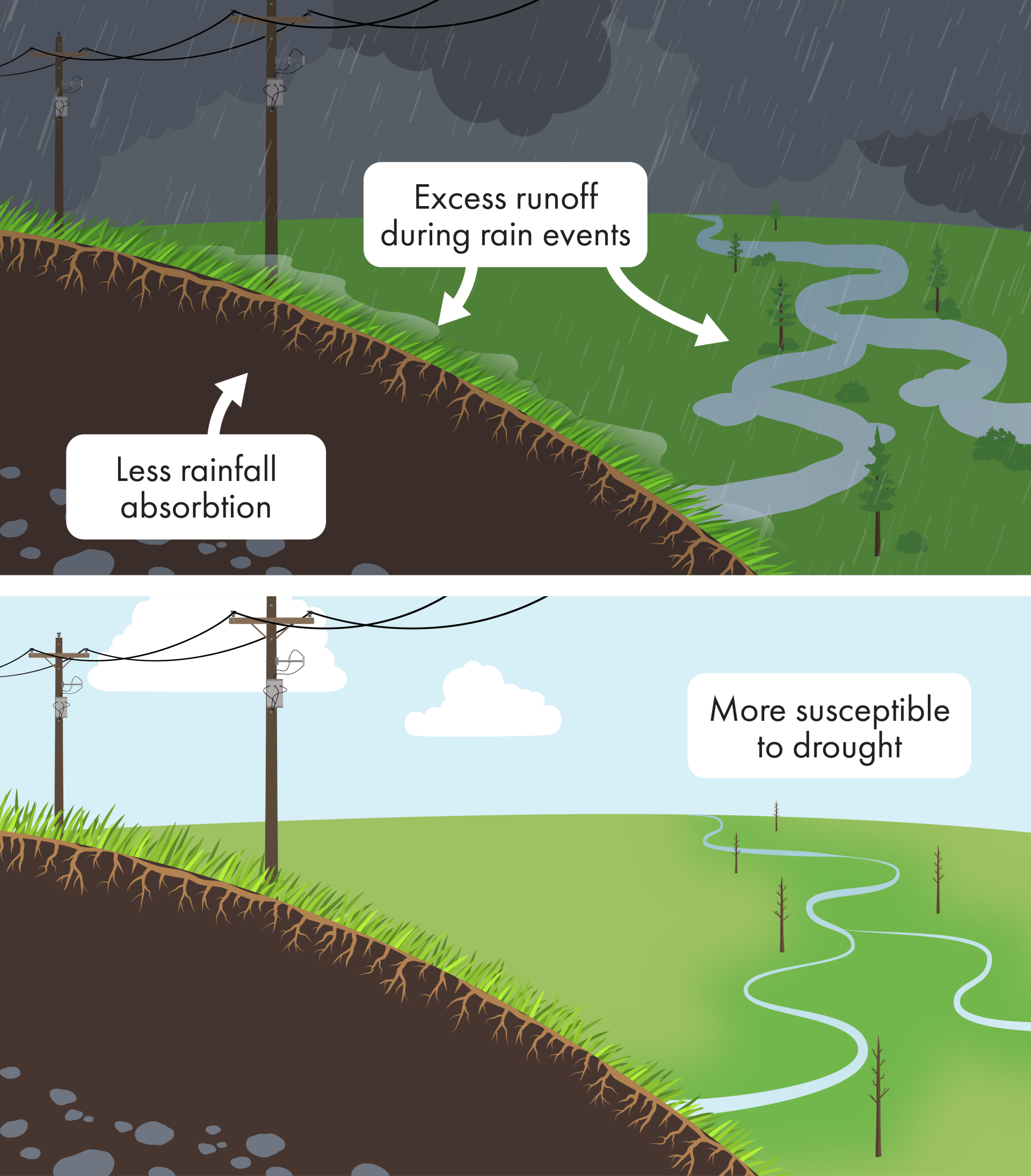
Routine mowing keeps ROWs clear and accessible but promotes shallow rooting and compaction that reduce the soil’s ability to absorb rainfall (Figure 1). This can increase surface runoff and lessen the slow and steady release of groundwater to nearby streams after storms. Also, while cool-season grasses resist soil erosion through dense roots systems, they are highly susceptible to dry spells and the uniform nature of this type of plant community makes them less resilient to extreme weather and changing climate conditions.
Figure 1
Effects of Exclusive Mowing or Herbicide Regime on Watershed Health
Figure 1
Effects of Exclusive Mowing or Herbicide Regime on Watershed Health
Enhancing Stormwater Infiltration and Soil Stability
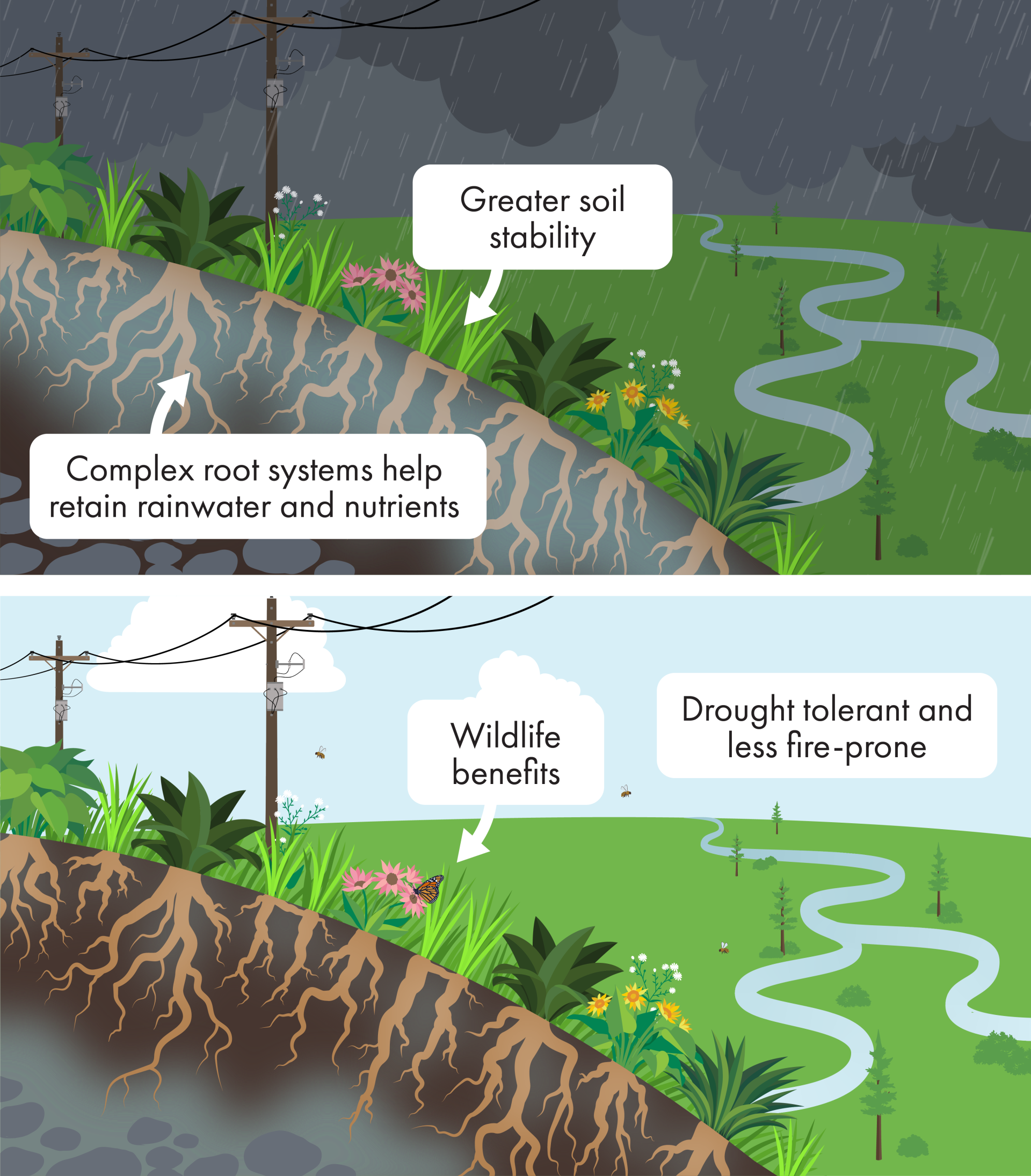
In contrast, IVM fosters diverse vegetation with deeper, more complex root systems that open soil pores and allow rainfall to soak in and recharge groundwater (Figure 2). These types of plant communities are more drought tolerant, provide greater soil stability, and trap sediment and excess nutrients before they reach waterways. Plus, they provide other ecosystem benefits, such as supporting pollinators and other wildlife. Improved water infiltration into soils supports healthier—and less fire-prone—plant communities. During dry seasons, the slow seepage of groundwater back into streams—called baseflow—often sustains most of a stream’s volume and provides essential cool water for fish and other aquatic species.
Figure 2
Effects of Integrated Vegetation Management on Watershed Health
Figure 2
Effects of Integrated Vegetation Management on Watershed Health
By enhancing soil water infiltration, stabilizing soils, and trapping sediment and pollutants, well-managed IVM corridors can enhance water quality in streams and in the surrounding watershed to help sustain aquatic life and moderate the effects of a warming climate.
References
Johnson, T., et al. (2022). A review of climate change effects on practices for mitigating the water quality impacts of urban stormwater, agriculture, and other nonpoint sources. Environmental Reviews. https://pmc.ncbi.nlm.nih.gov/articles/PMC9797054/
Selbig, W. R., & Balster, N. (2010). Evaluation of Turf-Grass and Prairie-Vegetated Rain Gardens in a Clay and Sand Soil, Madison, Wisconsin, Water Years 2004–08. U.S. Geological Survey Scientific Investigations Report 2010-5077. https://pubs.usgs.gov/sir/2010/5077/pdf/sir20105077.pdf
Sirimarco, M. X., et al. (2018). Water regulation by grasslands: A global meta-analysis. Ecohydrology, 11(4), e1934. https://onlinelibrary.wiley.com/doi/abs/10.1002/eco.1934
Swanston, C., et al. (2018). Midwest | Fourth National Climate Assessment. U.S. Forest Service. https://www.fs.usda.gov/nrs/pubs/jrnl/2018/nrs_2018_swanston_002.pdf
Técher, D., & Berthier, E. (2023). Supporting evidences for vegetation-enhanced stormwater infiltration in bioretention systems: a comprehensive review. Environmental Science and Pollution Research International, 30(8), 19705–19724. https://doi.org/10.1007/s11356-023-25333-w
Whitehead, P. G. (2009). A Review of the Potential Impacts of Climate Change on Surface Water Quality. Hydrological Sciences Journal, 54(1), 101–123. https://www.researchgate.net/publication/41571586_A_Review_of_the_Potential_
Impacts_of_Climate_Change_on_Surface_Water_Quality